




The Nigerian Communications Commission (NCC) has called for stronger collaboration among security agencies, government institutions, telecommunications operators and host communities to safeguard critical telecommunications infrastructure across Ekiti State.
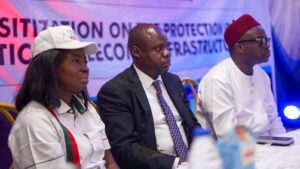
The Commission made the call on Tuesday, September 29, 2026, during a sensitisation programme on the protection of Critical Telecommunications Infrastructure organised by its Ibadan Zonal Office at the Ekiti State Civil Service Hall, Bank Road, Ado-Ekiti.
The programme attracted more than 160 participants, including representatives of the Department of State Services (DSS), Nigeria Security and Civil Defence Corps (NSCDC), Federal Fire Service (FFS), Nigeria Immigration Service (NIS), Nigeria Customs Service (NCS), Nigeria Police Force (NPF), Federal Road Safety Corps (FRSC), Ekiti State Fire Service, other government agencies, telecommunications operators and infrastructure companies.
Delivering the keynote lecture, the Zonal Controller of the NCC’s Ibadan Zonal Office, Engr. Isaac A. Akanbi, said telecommunications infrastructure was essential to national connectivity, economic activities and the delivery of digital services, stressing the need for collective responsibility in protecting the facilities.
He explained that telecommunications towers, switching stations, data centres, fibre-optic cables and satellite infrastructure had been designated as Critical National Information Infrastructure (CNII) under the Designation and Protection of Critical National Information Infrastructure Order, 2024.

According to him, the Order was issued by President Bola Ahmed Tinubu on June 24, 2024, pursuant to Section 3 of the Cybercrimes (Prohibition, Prevention, Etc.) Act, 2015, as amended.
Akanbi warned that offences against designated critical national information infrastructure attract severe penalties under the law, including 10 years’ imprisonment without the option of a fine, 15 years where an offence results in grievous bodily harm, and life imprisonment where it leads to loss of life.

He further explained that telecommunications networks rely on both active and passive infrastructure, noting that active components include base stations, switching equipment and transmission links, while passive infrastructure comprises towers, power systems, ducts and site security facilities.
He stressed that the protection of both categories was necessary to ensure reliable telecommunications services and prevent disruptions to network operations.
The NCC official also disclosed that more than 5,000 fibre-optic cable cuts were recorded nationwide in the first half of 2026, with road construction and excavation works identified as major contributing factors.
He therefore called for improved coordination between telecommunications operators, road agencies and construction contractors before excavation or other activities capable of damaging underground cables commence.
Akanbi also cautioned against the use of unauthorised signal boosters, warning that such devices could interfere with licensed telecommunications networks and affect service delivery.
On the role of host communities, the Zonal Controller described residents as the Commission’s first line of defence in protecting telecommunications facilities.
He urged community members to report suspicious activities around telecommunications towers and cable routes to the appropriate authorities rather than resort to self-help.
Addressing concerns about radiation from telecommunications infrastructure, Akanbi said a typical base station’s transmit power of between 20 and 30 watts was lower than that of an ordinary household light bulb. He also cited findings by the World Health Organization and the International Commission on Non-Ionizing Radiation Protection, stating that exposure levels within applicable guidelines had not been shown to cause harmful effects in humans.
During the interactive session, participants sought clarification on issues relating to unauthorised signal boosters, radiation, infrastructure sharing, the protection of cable routes, the security of telecommunications sites and collaboration between the NCC and other government agencies.
In response, the Commission said its guidelines provide for a minimum distance of 10 metres between the nearest building and the legs of a telecommunications tower. It also noted that infrastructure sharing among operators had been approved as part of efforts to promote more efficient deployment of telecommunications facilities.
The Commission further stated that complaints submitted through its consumer portal email, [consumerportal@ncc.gov.ng](mailto:consumerportal@ncc.gov.ng), were attended to within six hours.
The NCC urged members of the public to promptly report vandalism, obstruction of access to telecommunications sites and other suspicious activities around network facilities to the Commission or the nearest security agency.
It reaffirmed its commitment to working with security agencies, state and local governments, telecommunications operators, infrastructure companies and host communities to protect critical telecommunications infrastructure and sustain reliable connectivity across the country.


