


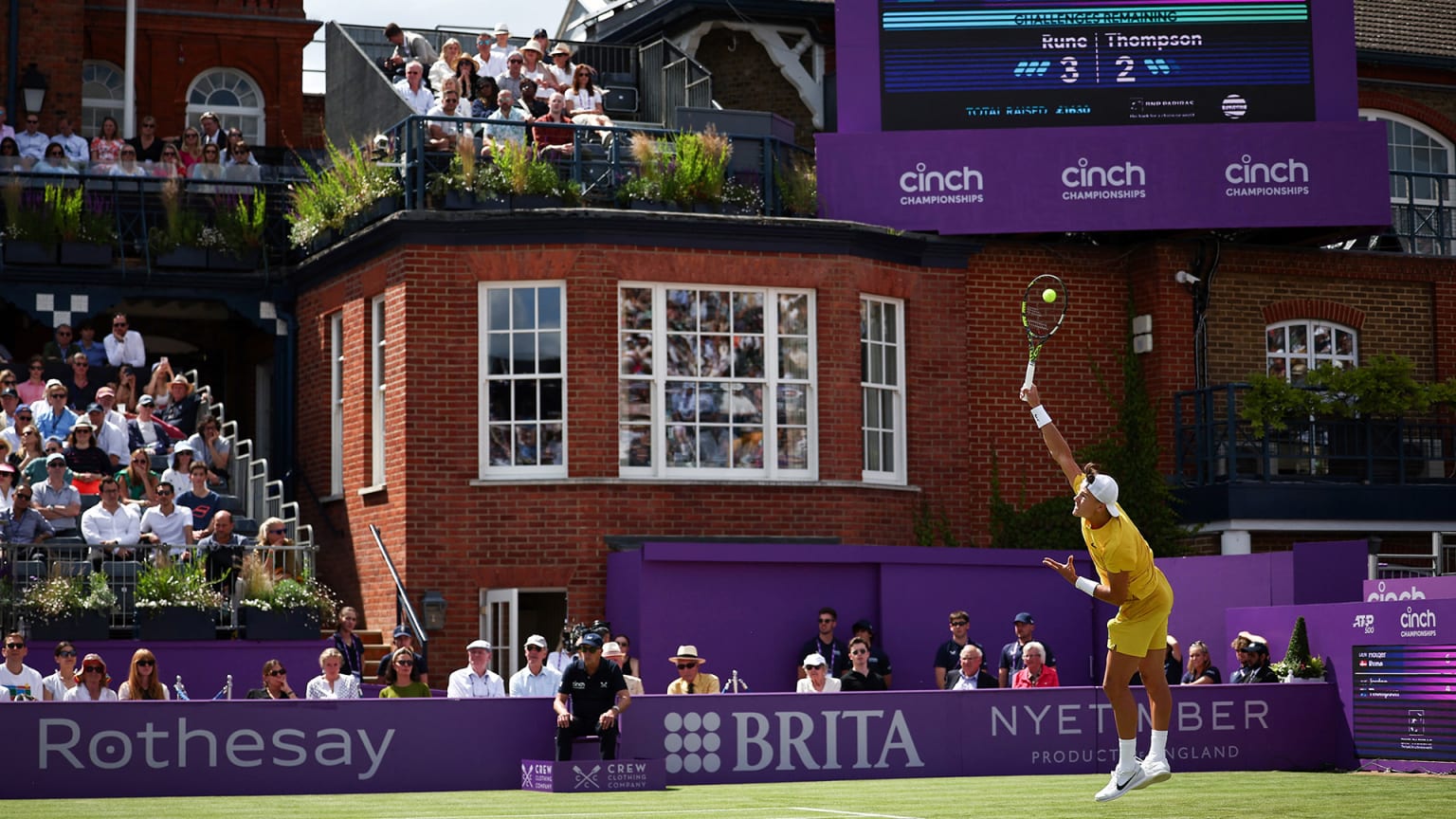
Many tennis players—and international sports stars, period—avoid competing in the United Kingdom due to the country’s uniquely overreaching financial system.
When two-time Stuttgart champion Matteo Berrettini packed up his racquets after reaching the BOSS Open final on Sunday, he stayed in Germany to continue his grass-court season in Halle, at the Terra Wortmann Open.
It was a move that raised a few eyebrows because it meant the Italian wouldn’t be playing at Queen’s Club in London, where he’s twice been champion—first in 2021, the same year he reached the Wimbledon final. But it was also notable because it meant Berrettini joined a growing wave of top players who are completing their Wimbledon warm-up away from the United Kingdom, opting for tournaments in Germany (Berlin, Bad Homburg, Halle), the Netherlands (‘s-Hertogenbosch) and Spain (Mallorca)—while draws in Nottingham, London and Eastbourne struggle to attract global stars.
The cinch Championships at Queen’s Club may be the best example of this trend. Despite being just a half-hour’s drive from Wimbledon, the ATP 500-level tournament featured just two Top 10 representatives, Carlos Alcaraz and Grigor Dimitrov. By contrast, the entry list at Halle is loaded with stars, featuring six Top 10 players including world No. 1 Jannik Sinner, Daniil Medvedev and Stefanos Tsitsipas.
This gulf in star power is apparent on the WTA Tour as well. Only three Top 10 players will hit the lawns in England at all this summer, with Ons Jabeur competing in Nottingham last week and Elena Rybakina and Jessica Pegula both scheduled for Eastbourne next week. The rest, including megastar and former No. 1 Naomi Osaka, are competing abroad.
What’s behind this great British drop-off? Though the country has historically been associated with lawn tennis and the grass-court season, international athletes have been avoiding the UK for years—thanks in large part to the country’s uniquely overreaching tax system.
“This is very difficult. I am playing in the U.K. and losing money,” Nadal on his decision to play Halle instead of Queen’s Club in 2012.
Rafael Nadal, the 2008 champion at Queen’s Club, was one of several sports stars who sounded the alarm back in the 2010s, along with the likes of sprinter Usain Bolt, golfer Phil Mickelson and other top athletes. The Spaniard was a regular in London, having played there in 2006, 2007, 2008 and 2011—but he didn’t mince words when asked why he wouldn’t be back the next season.
“The truth is, in the UK you have a big regime for tax,” Nadal explained in 2011. Helped along by a generous appearance fee, Nadal opted to play Halle in 2012 instead, returning only once more to Queen’s Club, in 2015.
While every country has its own rules around taxes, and each player should fulfill the financial obligation to their own, the UK’s situation is particularly vexing for global athletes. That’s because international players are taxed not just on the income they make in the country, like prize money earned at tournaments, performance bonuses or appearance fees for sponsor events, but also on income from outside of the country—including their image rights, sponsorship deals and brand endorsements.
https://www.instagram.com/p/C8M0uB9NReg/?utm_source=ig_web_copy_link
“When you got to the finals of Wimbledon, you spent X amount of days in the UK getting ready for it,” said Max Eisenbud, vice president at IMG and ‘superagent’ to top earners like Maria Sharapova, Li Na and Emma Raducanu, on a recent episode of Served with Andy Roddick. “And these days, they (HM Revenue & Customs) will proportion off from your Lacoste (deal) and how much money you made from Lacoste, (based on) how many days you were in the UK.
“They will get their little sliver of portion off of that. So your tax people need to be on top of that.”
According to GOV.uk, “a share of endorsement or sponsorship income is chargeable to UK tax” with that amount based on “how much time you spend performing and training” in the country. Taxable days naturally include competition days, but media days, practice days and recovery days also count, as well as gym days and even sponsor promo days. And unlike at one-off events like this year’s UEFA Champions League final or the 2012 Olympic Games, there are no exemptions for tennis players at regular, annual events like Wimbledon, Queen’s Club or Eastbourne.
https://www.instagram.com/p/C8P7CoWK3ro/?utm_source=ig_web_copy_link
That may not be much of a problem for the average Top 100 player with a standard set of racquet, apparel and shoe deals, or if they are living comfortably in the Top 50 with the backing of a few national or international brands. But once blue-chip brand names like LVMH, Rolex, Gucci and Richard Mille enter the mix, the balance quickly starts swinging in the opposite direction, and the sport’s most popular players can actually be left in the red.
For players who have to rely more on sponsors instead of prize money during a lean stretch of their career—such as Berrettini returning from injury, or Osaka from maternity leave, for example—it makes even less financial sense to compete in the UK.
“They take from the sponsors, from Babolat, from Nike and from my watches,” Nadal explained back in 2011. “This is very difficult. I am playing in the UK and losing money.
“I did (pay) a lot more for the last four years, but it is more and more difficult to play in the UK.”
There is a reason why Federer never got ready for Wimbledon in the UK.
Max Eisenbud, IMG vice president
Tax bills for international athletes start to get astronomical the longer they compete in the UK—and the higher up on the Forbes list that they feature.
To understand just how much it costs, take for example a star tennis player on the comeback trail with a stable of endorsements—let’s say $15 million a year’s worth—but who ends up losing in the first round of Wimbledon.
Not even the record $76,000 in first-round prize money would make a dent for the kinds of athletes subject to the UK’s 45% additional tax rate. Start adding more time in the country for tune-up events in Nottingham or Eastbourne, where there’s even less prize money on offer, and it’s easy to understand why the math just doesn’t add up:
Wimbledon Tax Example
Prize money (first round): $76,000
Travel Expenses: -$10,000
Endorsements: $15,000,000
RTPD Allocation (15/300 x $15,000,000)
($750,000)
Total income accessible to UK tax
$816,000


